


Eco-curious, eco-minded, but not eco-anxious…
12 October, 2022
I used to be more of a stickler about my environmental convictions. Having kids put a lot of things in perspective, and I've learned to compromise a little (sometimes more, sometimes less!). You pick your battles, as they say!
The fact is, it has always remained very present in my daily life, even if it's more flexible now. I want my kids to grow up with a desire to make a difference, even on their very small scale. I want our family's choices to be in line with our green values.
But how do we talk to kids about the environment?
How do we explain polluted oceans, endangered species, natural disasters caused by climate change, deforestation... without scaring them about the future? More and more young people say they feel a great deal of anxiety about environmental conditions.
How do we raise awareness without being too alarmist with our little ones?
How do we protect childhood while talking about eco-responsibility?
Whoa! Quite the challenge, I'd say! In this article, I'll try to answer these questions by showing you how we try to teach our kids the importance of making eco-responsible choices every day. Our green journey isn't perfect! We move forward in small steps. We make discoveries and we learn… a little every day! We read up a lot. With every book we read, we become a slightly greener tribe!
Curiosity first!
Before telling my kids that it's important to do this or that for the environment, I wanted them to see the beauty of nature. I wanted to cultivate their curiosity about everything around them.
My kids love animals. Like all kids, really! We read several books, mostly nonfiction, to learn more about animal life: their habitat, their diet, their predators. This led my boys to understand that it's important to respect the forest and the trees. We explored Élise Gravel's Disgusting Critters series to get to know the little animals that “spoke” less to my tribe. They loved it! They saw that every species matters, even if the animal is “gross”!
We followed up with nonfiction books about plants and insects. Yes, yes, we read quite a lot! And when we're not reading, the kids flip through the pages and look at the pictures (I'm leaving you a few reading suggestions at the end of the article!).
We spent a lot of time outdoors watching birds*, plants and trees. We went on treasure hunts, Nature Walk edition. We filled pages of our copies of the Nature Journal. We watched tulips and buds slowly emerge.
We grew herbs and vegetables. We started seedlings, but also mango and avocado pits, lemon seeds, a piece of ginger, a pineapple top. I wanted them to see where what we eat comes from. How long it takes to wait to harvest a tomato, and how important it is not to waste food. Now, whenever we make guacamole, the kids ask me to grow a plant!
We have laying hens that the kids love! We explain to them that we have to take care of them because they give us food.
I told myself it was impossible to show my kids that the environment matters if it's unfamiliar to them. If we never spend time in it. We also read Greta and the Giants. In it, they found a little girl (Greta Thunberg!) who stands up to giants who are destroying the forest. My kids understood that even if you're small, together with others you can make big changes. Mission accomplished! Yeah!
Explain the why, but not too much
When I'm asked to do something, I like to know why. That's why when I ask my kids to do a certain thing and they ask me why, I don't just answer “because that's how it is!”.
That said, I don't go on and on with the explanations. For example:
- We don't leave the tap running when we brush our teeth, to avoid wasting water.
- We use reusable water bottles, reusable containers and cloth bags so we don't throw things away every time. That creates less waste.
- We bring our own bags for fruits and vegetables at the grocery store to avoid bringing home plastic unnecessarily.
That's it.
They don't need to know the rest for now. At our house, the more detailed explanations will come later.
We're also starting to use food scraps. You know, those parts of vegetables we usually throw out (ideally they'd go to the compost or to the hens, by the way!). Before tossing a piece of vegetable or fruit, we ask ourselves if it couldn't have a second life. That's where I discovered Chic frigo sans fric (in French) and Florence-Léa Siry. I like the author's optimistic approach, which encourages us to make changes without making us feel guilty.
This summer, I want to start foraging for wild plants with the kids. I learned from a Quebec guide called “Forêt” (French only) that several plants on our property are edible. (For English-speaking foragers in North America, try Nature's Garden by Samuel Thayer, a guide to identifying, harvesting and preparing edible wild plants.) By identifying and cooking them, I'll be able to show the kids that nature offers us food almost everywhere, sometimes without our even realizing it! Isn't it amazing?! One more reason to take care of it!
Raising awareness without guilt-tripping
I want my kids to be proud of the small actions they take. I want those actions to become automatic, and I want them, in their daily lives, to take thoughtful actions that will have an impact on the environment, however small.
I don't want them to be in a constant state of stress and anger because they can't control everything. One small action at a time, while trying to be a better person day by day. Continuous improvement!
As a family, we can also look for alternatives we could put in place to improve. Kids will surely have lots of ideas for making your daily life more eco-responsible. The idea is to see whether each alternative is workable in your reality. Often, choices that come from us are more motivating!
We won't bring about change by being negative. We have to keep hope and see everything that can be done. One small step at a time!
My reading suggestions for kids:
- For English-speaking families, try The Grouchy Ladybug by Eric Carle, a classic picture book about insects (the author's French-language pick, “Les bestioles” by Pamela Hickman and Carolyn Gavin, has no English edition that we know of)
- Nature All Around: Trees (in French), Pamela Hickman and Carolyn Gavin (2019)
- For English-speaking families, try Everyone Poops by Taro Gomi, a classic on the same theme (the author's French-language pick, “Tout sur le caca (et sur les autres traces laissées par les animaux)” by Andy Seed, has no English edition that we know of)
- Blue Planet: Life in Our Oceans and Rivers, Moira Butterfield (2019)
- La Terre en vert: la vie dans nos bois et nos forêts (in French), Moira Butterfield (2019)
- Here We Are: Notes for Living on Planet Earth, Oliver Jeffers (2017)
- All the books in the Disgusting Critters series, Élise Gravel
- Curiositree: Natural World, A. J. Wood and Mike Jolley (2016)
- Greta and the Giants, Zoë Tucker and Zoe Persico (2019)
- For English-speaking families, try Wild by Emily Hughes, a picture book for ages 3 to 7 about a free-spirited forest child in a tidy, “civilized” world (the author's French-language pick, “La tribu qui pue” by Élise Gravel, has no English edition that we know of)
My reading suggestions for parents:
- Books by Florence-Léa Siry (in French)
- Books by Marie Cochard (in French)
- For English-speaking families, try Nature's Garden: A Guide to Identifying, Harvesting, and Preparing Edible Wild Plants by Samuel Thayer, which also teaches you to find and cook wild edibles (the author's French-language pick, “Forêt: identifier, cueillir et cuisiner” by Ariane Paré-Le Gal, has no English edition that we know of)
* Québec Oiseaux (in French) offers a great resource for birdwatching. My kids love it!
Would you like first access to all the content published in the Magazine each month, plus our Toolbox, which includes, among other things, free downloads that are as practical as they are fun? Subscribe to Belles Combines Magazine today!
Put these tips into practice
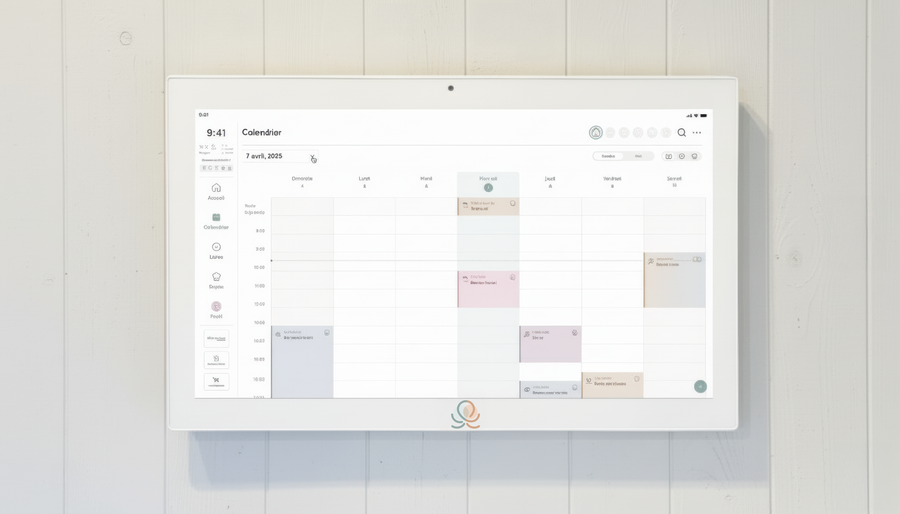
Get the whole family organized with Octave
Meals, chores, the calendar and routines for the whole family in one place: on everyone's phone and on the Station on your wall.
The app is free on iOS and Android.
1 comment
C’est un très beau texte qui en dit long et qui reflète en même temps ta joie de vivre.