



Psychological safety: developing inner confidence as an adult
12 May, 2023
Psychological safety
Developing a sense of inner security and confidence, as an adult
“Anxiety is the scourge of our time!”
You've surely heard something along those lines, or read somewhere, that anxiety affects more and more children and teens. But it is just as present for us, young (and not-so-young) adults. (in French)
To experience less anxiety, you first have to feel safe. And what is safety? It is first and foremost a feeling (an assessment and awareness of dangers).
Do I feel safe in my neck of the woods, in my house, in my family or in my workplace? When it comes to physical safety, it's usually fine.
But the question also arises when it comes to psychological safety.
How can we ensure our own psychological safety as adults, and how can we foster it within a group (at work or in the family, for example)?
First, what is psychological safety? It is the ability to share ideas, emotions, questions and concerns without fearing personal repercussions (or the other person's reaction).
The psychological safety we feel therefore has a lot to do with the emotional skills of the people around us, which is why it's important to choose your life partner and your workplace carefully.
That said, creating a climate of psychological safety and kindness is also something cultural, something that can be modeled, learned and practiced!
- In the teams we support (a family is a team too!), we first encourage authentic exchanges, even vulnerable ones.
- This means being honest about our human experience, with its highs and lows: our level of fatigue, our sadness, our griefs and disappointments, our dreams, our values, our joys, our desires. Team members can thus feel a sense of connection and closeness around their shared experiences while at the same time accepting the differences and the great diversity of experiences, points of view, realities, needs and emotions.
- Normalizing universal human emotions and needs lets us cultivate empathy: I may not “understand” or “share” the cause of your emotions, but I can remember, as a human being, having felt that same emotion.
- Finally, offering flexibility and autonomy lets us honor that diversity and share responsibility. With a looser framework, everyone has a little more latitude to meet their own needs while considering those of others! No need is denied or refused, and we encourage each other to meet them within a reasonable time!
Inner security
Alongside psychological safety within a group, we can ask ourselves about our own inner security and about ways to increase it. A psychoeducator I know recently spoke about the “alert level” we find ourselves at.
For my part, I've thought a great deal about my tendency to quickly climb the walls (put myself in a state of alert), the main sign that my inner security is shaken.
In my own experience, accepting all emotions has helped me a lot to react less negatively to certain so-called negative emotions, and exposure to uncomfortable situations that aren't truly dangerous has helped me build my self-confidence and my confidence in my ability to adapt. Yes, yes, as an adult!
Strategic introspection:
- Do I have confidence in my ability to adapt? Am I afraid of certain sensations or emotions? Am I able to experience my emotions, all my emotions, without perceiving them as threatening, without reacting to silence or transform them?
- Do I trust the world around me, or am I constantly envisioning the worst-case scenario, preparing to be disappointed or thrown off balance? Why? Am I able to distinguish a real risk and danger from a risk or danger amplified by my thoughts?
- Does the environment I'm in right now offer me kindness and psychological safety?
- Is this a sign to seek help or to change jobs?
- How could I create a caring, safe circle around me?
That's as many questions to mull over as there are courageous actions to take.
Psychological safety is also modeled for our children! From the perspective of reducing anxiety, turning inward is therefore an interesting first step.
Put these tips into practice
Get the whole family organized with Octave
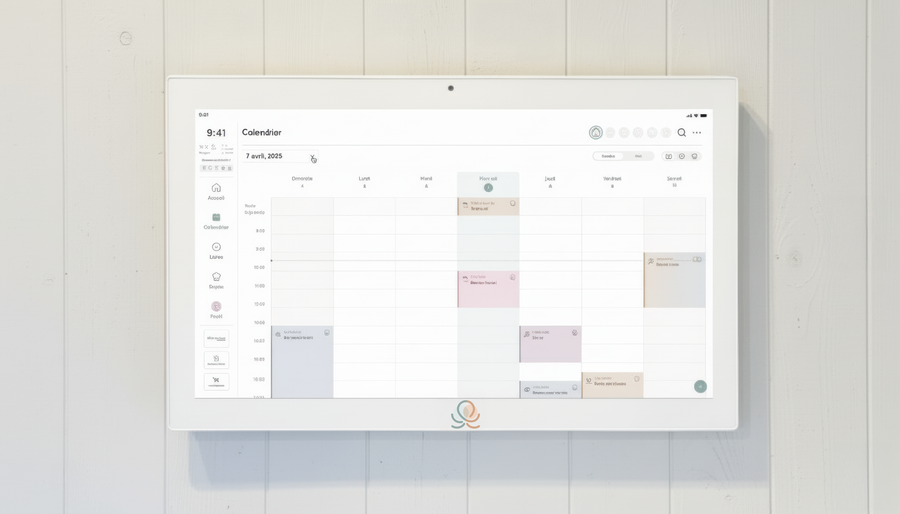
Meals, chores, the calendar and routines for the whole family in one place: on everyone's phone and on the Station on your wall.
The app is free on iOS and Android.