



Building zen moments into your family schedule
01 April, 2025
By Dominique Bernèche
In our first article, I shared my own trap with you: the trap of perfect organization that backfires on us. I came to understand that our planning tools, however powerful they are, can pull us away from our original goal of serenity if we use them poorly. Today, I'd like to show you how I managed – and how you can manage – to concretely build in moments of calm that make all the difference.
The 80/20 principle: when my partner opened my eyes
It was my partner who pointed out, with his usual common sense, that I was always adding more to our family calendar. “Maybe we could slack off a little on the commitments, no? It would be fun to sometimes NOT OVERTHINK IT,” he told me one evening while I was juggling our schedules for the month.
That remark, combined with the 80/20 principle inspired by the Pareto principle, led me to rethink our approach: I now firmly plan only 80% of our available time, leaving 20% for the unexpected, spontaneity or simply relaxing. I don't calculate it down to the minute (it's not a religion, after all), it's a guide. That 20% isn't “wasted” time – it's essential room to maneuver, so we can absorb life's daily surprises without being in a constant state of stress, and simply enjoy ourselves with no pre-set agenda.
In practical terms, here's how this principle can be applied:
-
For a typical week: Out of the 7 days, schedule activities or appointments on no more than 5 or 6 days. Keep at least one day entirely free of any outside commitments. I've noticed that the families who manage to keep up this rhythm, even with kids enrolled in various activities, limit those activities to 5 days a week at most, which lets them protect Sunday as a “no-agenda” day.
-
For a typical day: Out of the waking hours (about 16), I make sure not to fill more than 12 to 13. For a weekend family day with about 12 active hours (from 9 a.m. to 9 p.m.), I plan 9 to 10 hours of activities at most, which leaves us 2 to 3 hours that are completely free.
-
For vacations: Over two weeks off, I now set aside at least 3 days with no pre-set plans. My friend Stéphanie, a mother of two, told me: “We now plan 3 ‘blank days’ during our two weeks of summer vacation. No reservations, no itinerary, NO PLAN. Those days have often become the most memorable, like the time we decided to make our own ice cream. It's become a little ritual the kids love, and we try new flavors every year.”
The efficiency gained from planning tools should be used to widen this buffer zone, not shrink it by adding ever more activities. And I'll share a secret I've discovered: it's in these unscheduled, spontaneous spaces that the most memorable moments of our family life are often created.
With this new philosophy well established, the question became: how do we get the full benefit of that precious 20%? How do we concretely turn certain time slots into true moments of serenity? How do we make sure these moments don't themselves become a new source of pressure (“I absolutely have to relax right now!”)? Let's dive together into the art of building in zen moments that truly deserve the name.
Why I always sacrificed my zen moments first
“The moment I sit down for an hour of quiet reading on Sunday, my partner starts doing the laundry. Eaten up by guilt, I put my book down and start vacuuming.” Or: “I was going to take a relaxing bath? No, finishing this urgent project will give me more peace of mind than the bath, so let's go for the project.”
I've often had these reflexes, and I'm still working on countering them. Paradoxically, the moments set aside for my relaxation were the first ones I sacrificed when my schedule got tight. I justified it by claiming that putting certain responsibilities behind me would be more of a lifesaver than moments of respite that would push those same responsibilities back even further (most of which I'd imposed on myself).
Admit it, you do the same... and when you sit down to do nothing, you often hear the echo of your parents telling you it's wasted time, that you need to keep busy. Or, if you aren't getting busy at the same time as your partner, you feel bad watching them bustle around alone. These inner voices, inherited from how we were raised, are powerful and hard to silence.
This unspoken ranking of priorities explains why, even when they're written into our calendars, zen moments regularly end up sacrificed on the altar of efficiency and social obligations.
Rethinking the value of moments of calm
Neuroscience teaches us that our brain fundamentally needs breaks to function optimally. These moments of disconnecting allow for:
-
Consolidation of learning and memory (hello, connections I can make between what I learn and everyday life)
-
Emotional regulation (bye-bye, anxiety and needless stress)
-
The development of creativity (hello, new ideas that find it easier to make room in my unoccupied brain)
-
A stronger immune system (thanks, germs, the door is closed)
-
Better quality sleep (hallelujah for nights without insomnia)
Recent neuroscience research is clear: these breaks aren't a luxury but a true physiological necessity, comparable to food or sleep. As Dr. Sonia Lupien, a neuroscientist and director of the Center for Studies on Human Stress, explains, our brain isn't designed to operate in a constant state of alert. Periods of recovery are essential to maintain our ability to manage stress. Without these breaks, we deplete our cognitive and emotional resources, which ultimately compromises our mental and physical health.
This change in perspective was fundamental for me. When I understood that these calm moments are as essential to how my brain functions as sleep is to my body, the way I organize our family life was profoundly transformed. Breaks stopped being negotiable and became a priority.
The key was understanding that zen moments aren't pleasant but optional interludes: they're a fundamental pillar of my mental and physical balance, and of my children's. It's no longer time I “steal” from my productivity, it's time I invest in our collective health.
Three categories of zen moments to explore
For a truly balanced schedule, I recommend exploring three complementary types of zen moments to deliberately build into your schedule:
1. Daily micro-breaks (5 to 15 minutes)
These short breathers punctuate the day, offering gentle transitions between different activities. Their brevity makes them easier to protect, even on the busiest days.
For me personally, these micro-breaks take the form of:
-
My glass of wine on the porch on summer evenings
-
My herbal tea by the fireplace during the winter months
-
My 3-minute stretches during my workday
-
A short brisk walk around the block to clear my head
-
Bedtime story time with the kids
Other ideas I've seen work for the families I coach:
-
5 minutes of mindful breathing before starting the car
-
A “contemplation” break at the window with a cup of tea
-
A ritual cuddle time when the kids get home from school
-
Some sky-watching time before bed
How to build them in: Pair these micro-breaks with actions already in your routine (after brushing teeth, before the meal, when the kids get home from school) to make them easier to adopt.
2. Weekly rituals (30 minutes to 2 hours)
More substantial, these moments allow for true disconnecting and foster family reconnection. Their regularity creates a soothing rhythm and stable landmarks for every member of the family.
Personally, I love our cooking afternoons where we make muffins or homemade pasta together. This moment of collective creation nourishes much more than our stomachs!
Other families successfully put in place:
-
A long Sunday breakfast with no screens and no time constraints
-
A Saturday morning nature walk
-
A family reading session in the evening
-
An hour at bath time turned into a weekly “spa”
-
Board game nights without distractions
-
A family workout session (yoga, running, biking) where the goal isn't performance but the pleasure of movement
How to build them in: Write these rituals into the family calendar in a distinctive color. Treat them as just as important as a doctor's appointment – because they're essential to your “family health.” One trick is to present them to the family not as obligations but as privileges.
3. Seasonal breaks (1 to 3 days)
These longer breaks allow for real renewal and create lasting memories. Just looking forward to them already generates well-being in the family.
Some inspiring examples I've seen among my clients and the people around me:
-
A quarterly “no-schedule” day where improvisation reigns
-
An unplugged weekend out in nature at every change of season
-
An annual family retreat in an inspiring place
-
A seasonal creative project done together over several days
-
A tidying and decluttering ritual that frees up physical and mental space
Nathalie, a participant in my workshops, shares: “We introduced what we call ‘the bubble day’ once a season. The rules are simple: no screens, no social obligations, no work or homework, and above all, no watch! We simply follow our natural rhythm. These days are like oases in our hectic life.”
How to build them in: Plan these special moments several months in advance so they aren't gradually nibbled away by other commitments. Put them into your annual schedule first, ideally even before the school holidays.
How to protect these moments from intrusions
I can hear you! You find this idea interesting but a bit frivolous, and you tell yourself you don't need to put these moments on the calendar, that you'll manage to do it on your own. I know because I had exactly the same thoughts. However, since the whole family doesn't live at the same pace, there's always someone who upsets the plans. Scheduling them can therefore turn out to be a good idea. Deciding to build in zen moments is a first step. Protecting them in this hyperconnected world is another, but it's possible.
Setting clear boundaries
The key is to establish explicit limits, both for yourself and for those around you.
Strategies that work:
-
Proactive communication: Let those around you know about these protected times. Careful, though, no overly formal language – we're not robots! Simply say that you've put sacred periods on the calendar and that you're counting on them to respect that. Use humor to name these moments: “Mission Inaction,” “Rocking Chair Break,” “Veggie Phase,” “Vegetative Session” or “Recharge Break.”
-
Visual signals: Use clear signs to mark these moments. A special candle, a flag, a particular outfit (call it “THE SUIT OF INACTION”), or even specific emojis in the family schedule.
-
No negotiation: Establish that these moments are non-negotiable, exactly like bedtime. Protect them the way a pit bull guards its bone!
-
Devices in airplane mode: Every time during these periods, no exceptions. The world will keep turning without your thumbs on the screen, promise.
-
Dedicated space: If necessary, create a physical boundary for some of these moments. A corner, a room, a designated armchair.
One family developed a ‘red flag’ system at home. When the flag is on the living room door, it means ‘quiet time in progress.’ The kids themselves helped come up with this rule and crafted the flag, and they respect it surprisingly well. The symbol is simple but effective.
Managing internal resistance
Often, the biggest resistance comes from ourselves: feelings of guilt, the sense of “wasting time,” intrusive thoughts...
Practices that can help:
-
Start small: begin with 5 minutes, if that's enough
-
Remind yourself of the scientifically proven benefits: it isn't wasted time
-
Focus your attention on something that does you good and puts you in a state of flow (reading, cooking, puzzles)
-
Accept imperfection: a zen moment isn't necessarily a perfectly calm moment, especially if you have kids, so lower your expectations
“At first, I felt guilty about ‘doing nothing’ during our afternoon break,” Caroline confided in me at a workshop. “Not to mention that without things to do, the kids tended to bicker or complain that they didn't know what to do. Then I started noting the changes in our family dynamic: fewer conflicts, better sleep, deeper conversations... That tangible proof swept away my guilt. Now the kids easily find something to occupy themselves.”
I've lived through exactly the same experience.
When zen moments become second nature
With time and regular practice, these zen moments stop being conscious efforts and become second nature, woven into the family DNA.
Here are the signs that showed me our zen moments were bearing fruit:
-
My kids started to appreciate these moments and even ask for them
-
I noticed better emotional regulation in every member of my family
-
Our daily transitions became smoother
-
The quality of our family communication improved noticeably, and even my teens talk to me more
-
I no longer feel the famous FOMO when I'm doing nothing
-
I'm reassured: even while taking these breaks, I don't run short of time for what's essential
Cultivating the art of the present moment together
Building zen moments into our family schedule has been much more than a simple organizing technique: it has become a way of collectively cultivating the art of the present moment, that ability to be fully there, together.
I've come to understand that these spaces of calm aren't parentheses in “real life,” but perhaps the very moments when we live most authentically. After all, what is a balanced family schedule if not a tool that lets us regularly remind ourselves of what truly matters?
Coming back to our starting point: our organizing tools are extraordinarily powerful, but they're only tools. It's up to us to use them wisely. The real goal isn't to fill every minute of our schedule, but to deliberately create pockets of air in it, moments of breathing room that give meaning to everything else. It's in this balance, this alternation between action and rest, that true productivity lies – the kind that nourishes our lives rather than exhausting them.
In the next article in our feature, I'll share the daily habits that helped us gain in calm and efficiency – those micro-routines that, once automated, free up our attention and energy for what's essential.
This article is part of our special feature “A Family Schedule That Breathes,” published in the April 2025 issue.
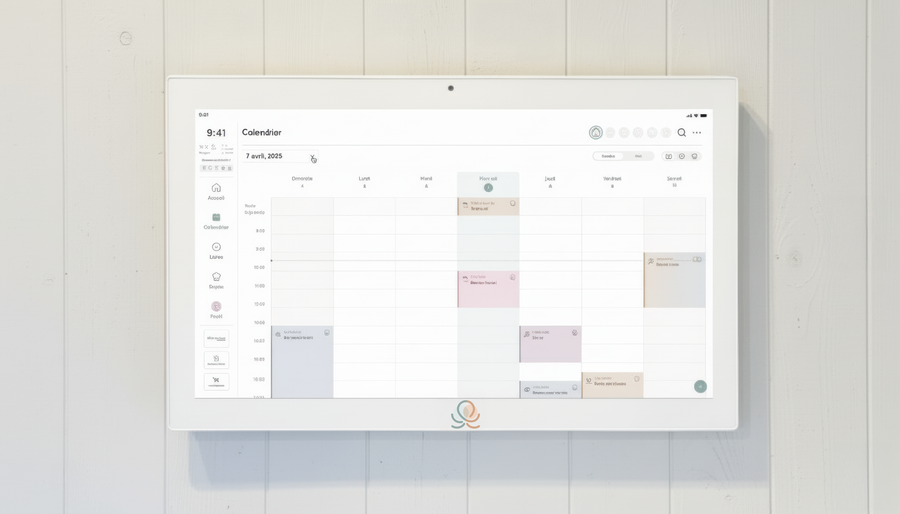
Put these tips into practice
Get the whole family organized with Octave
Meals, chores, the calendar and routines for the whole family in one place: on everyone's phone and on the Station on your wall.
The app is free on iOS and Android.