



Dividing household chores: avoiding marital war
16 October, 2025
The situation is similar from one household to the next: household chores are most often divided unfairly, and let's admit it, most of the time at the woman's expense. And while one of the two partners ends up exhausted and overwhelmed by the sheer volume of chores that fall to them, the imbalance increasingly affects daily life and family harmony. What if we told you there's a completely different way to approach household management?
The uncomfortable numbers: the reality of how chores are divided
Before presenting concrete solutions, let's take a moment to look at the facts. The statistics are clear and fairly consistent over the years: women do an average of three and a half hours of domestic work per day, while men devote only two hours to it, a significant difference of an hour and a half.
Even in couples where both partners work full time. Even in couples who consider themselves “egalitarian.” Even among couples where the man claims to “do a lot.”
Why does this inequality persist?
No, it's often not because men are lazy or because women are comfortable in this unequal situation. Often, the situation stays as it is, of course, because of the society we live in, but also because many couples have never taken the time to have an explicit, detailed and honest conversation about what “running a household” really involves. Their division of tasks is simply based on inherited social habits, unspoken expectations and an enormous blind spot: the mental load.
Why “Ask me and I'll help” solves absolutely nothing
How many times have you heard (or said!): “Just ask me and I'll do it!”? Although it seems reasonable on the surface, this ordinary sentence reveals exactly the nature of the problem.
The problem with the word “help”
When you “help,” you're assisting someone with THEIR task. You're the assistant, not the person in charge. “Helping” therefore implies that running the household belongs to one person, and that the other kindly steps in when asked.
Yet running a household is a shared responsibility. No one should “help” the other run HIS (or HER) home; both should instead run THEIR home together.
The problem with “ask me”
Asking requires you to:
- Notice that a task needs to be done
- Remember that task
- Work out when it needs to be done
- Decide who is available to do it
- Make the request
- Keep an eye out to see that it gets done
- Check the quality
- Sometimes, ask again or finish it yourself
That's the mental load.
An important distinction: visible vs. invisible tasks
To break out of this impasse, you first need to understand that household tasks fall into two categories that are generally divided in a totally unequal way.
Visible tasks
These are the hands-on tasks you can see, measure and count:
- Washing the dishes
- Vacuuming
- Doing the laundry
- Taking out the garbage
- Making dinner
- Mowing the lawn
Often, these tasks are fairly well shared in many modern couples. One partner washes the dishes, the other vacuums. One does the laundry, the other takes care of the lawn. But these tasks only make up about 40% of the total domestic work.
Invisible tasks
These are the management, planning and coordination tasks – the famous mental load:
Planning and anticipating:
- Remembering birthdays and buying gifts
- Planning the week's meals
- Anticipating needs (we're out of toilet paper, new shoes are needed for school)
- Managing the family calendar and appointments
Coordination and logistics:
- Arranging child care
- Coordinating extracurricular activities (registrations, schedules, transportation)
- Handling paperwork (school forms, taxes, insurance)
- Planning family vacations
Emotional and social management:
- Remembering and maintaining connections with extended family
- Managing conflicts between kids
- Monitoring the kids' development and well-being
- Organizing family parties and events
Monitoring and restocking:
- Noticing when the kids' clothes no longer fit
- Keeping track of supplies (food, cleaning products, medication)
- Thinking ahead to future needs (school supplies, sports equipment)
These tasks that never stop are often the cause of exhaustion: even on vacation, even while sleeping, part of the brain stays constantly in “running the household” mode.
And these invisible tasks almost always remain 80 to 90% the responsibility of a single partner (you guessed it: the woman!).
The exercise that changes everything: listing ALL the tasks
You can't divide fairly what you can't see. So here's a fundamental exercise that every couple should do at least once, which will finally let you see all of the tasks that have to be done every day.
How to go about it
Step 1: Block off 90 uninterrupted minutes in your schedule
Whether it's a Saturday afternoon while the kids are busy or at their grandparents', or even during a dinner for two, this isn't a conversation to have on the corner of the table.
Step 2: Each person makes their own list (20 minutes)
Each of you take a sheet of paper and list ALL the tasks you do to keep the household running. Not just the big tasks: EVERYTHING you do needs to appear on the list:
- Physical tasks (dishes, laundry, cleaning)
- Planning tasks (meals, appointments, activities)
- Mental tasks (remembering, anticipating, monitoring)
- Emotional tasks (managing conflicts, maintaining connections)
To help you, use these categories as a guide:
- Kitchen: Plan, buy, cook, put away
- Home: Cleaning, repairs, organization
- Clothing: Washing, folding, putting away, shopping
- Kids: Care, homework, activities, appointments, development
- Finances: Budget, bills, taxes, planning
- Social: Family, friends, events, gifts
- Admin: Forms, insurance, correspondence
You'll also find a ready-made list in our Parenting Team special feature in the Magazine!
Step 3: Pool your lists (30 minutes)
Compare your lists. You'll discover:
- Tasks that one of you does and the other didn't even see
- Tasks that you both think you do (but that one of you actually does 80% of the time)
- Completely forgotten tasks that no one is really handling
Create a master list that combines your two individually made lists. Be exhaustive; aim for a minimum of about 50 to 80 tasks if you have kids.
Step 4: Estimate the time (20 minutes)
For each task, estimate:
- The frequency (daily, weekly, monthly, seasonal, yearly)
- The time required each time
- The total time required per week
Step 5: Identify who currently does what (20 minutes)
Next to each task, honestly note who mainly does it:
- A (Partner A)
- B (Partner B)
- 50/50 (truly equal)
- No one (neglected task)
Add up the hours each partner spends on tasks each week.
Step 6: Take stock
Now it's time to assess the real share of tasks, visible and invisible, that falls to each partner in the couple, to see the imbalance (as is often the case), and of course to start moving toward solutions!
The renegotiation conversation: a script that works
Now that you have the list and the numbers, it's time to move on to negotiations. Here are a few tips that will help you have this conversation without it turning into a conflict!
The framework for the conversation
What it is NOT:
- A time to blame or accuse
- A chance to dig up every past grievance
- A fight to prove who works harder
What it is:
- Team problem-solving
- An opportunity to rebalance for everyone's well-being
- An investment in your relationship and your family
The step-by-step script
Opening (overloaded partner):
“I want us to talk about how we divide the chores, not to criticize you, but because I'm exhausted and I know it's not good for me, for us, or for the kids. I did this exercise because I want us to find a solution together. Are you open to talking about it calmly?”
Presenting the facts (together):
“Here's what we discovered: the total domestic work is X hours per week. Right now, I do X hours and you do X hours. I'm not saying this to blame you – a lot of what I do is invisible, so it's normal that you didn't see it. But now that we can see it, I'd like us to change things.”
Listening (partner who does less):
“I realize I wasn't seeing everything you did. I'm sorry. I really want to contribute more fairly. Tell me what would be most helpful for you.”
Negotiation period
Go through the list together and redistribute. Use these principles as needed:
- Favour preferences: each person takes the tasks they dislike the least.
- Group tasks logically: whoever cooks should probably also do the grocery shopping.
- Take on the full mental load: if you take on the job of handling “meals,” you also take on planning them and carrying them out.
- Aim for a balance in terms of hours worked, not number of tasks.
Traps to avoid
❌ “But I work more hours outside the home!” → Domestic work is work too. Count the total hours (job + home) for each partner.
❌ “You're better at it than I am!” → That's often an excuse. You learn to do things well by doing them!
❌ “I'll try to do more.” → No. Specific commitments, not vague intentions.
The fair-division template
To help you, here's a simple model for a new division of tasks.
| Category | Task | Frequency | Time | Responsible | Notes |
|---|---|---|---|---|---|
| Kitchen | Plan meals | 1x/week | 30 min | Partner A | Sunday evening |
| Grocery shopping | 1x/week | 1 hr 30 min | Partner A | Saturday morning | |
| Cook dinner | 7x/week | 5 hrs | Partner B | Every evening | |
| Kids' lunches | 5x/week | 2 hrs | Partner B | Prepare the night before | |
| Home | Evening dishes | 7x/week | 2 hrs 30 min | Partner A | After dinner |
| Bathroom cleaning | 1x/week | 30 min | Partner B | Saturday | |
| Vacuuming | 1x/week | 45 min | Partner A | Sunday | |
| Kids | Morning routine | 5x/week | 3 hrs | Partner A | Wake-up to school departure |
| Evening routine | 7x/week | 5 hrs | Partner B | Dinner to bedtime | |
| Appointments | Varies | 2 hrs/month | Partner A | Dentist, doctor | |
| Homework | 5x/week | 2 hrs 30 min | Partner B | After school |
Total Partner A: 20 hrs/week Total Partner B: 20 hrs/week
Golden rules to follow
- Full ownership: if it's your task, you handle everything (planning + execution + mental load).
- No supervision: the other person doesn't check up on you or criticize how you do it.
- Negotiated standards: agree on the acceptable level of quality (no imposed perfectionism).
- Occasional flexibility: you can help each other out now and then, but each person's responsibility must remain clear.
The quarterly review: maintaining balance
A division of tasks is of course never set in stone: life changes, sometimes we change jobs, the kids grow up or we add new activities to our schedule. A regular review of the division you've set up helps prevent the imbalance from creeping back.
How to do your review
Every three months, block off 30 minutes to:
-
Evaluate what's working: What's working well? What should you keep?
-
Identify the pain points: What's causing friction? Which tasks are being neglected?
-
Adjust the load: Have needs changed? Are some tasks taking longer than expected?
-
Redistribute if needed: Swap tasks if someone is overloaded.
-
Celebrate progress: Acknowledge the improvements and each other's effort.
Guiding questions for the review
- Does either of us still feel overwhelmed?
- Are there tasks we could eliminate, simplify or delegate (cleaning, grocery delivery)?
- Are we keeping our commitments to each other?
- How has our relationship been doing since the new division of tasks?
War between spouses over household tasks isn't inevitable; it more often arises from invisibility, unrecognized imbalance and a lack of communication.
The solution, then, isn't to “ask for more help,” but to recognize that running a household is a real job in its own right, and that it's therefore important to divide fairly not only the execution but also the mental load that underlies all the household chores.
This exercise of making an exhaustive list and renegotiating isn't an easy task, of course; it takes time, honesty and sometimes even uncomfortable conversations. But couples who do it report fewer conflicts, more mutual respect and, above all: two partners who are less exhausted and happier.
Belles Combines solutions
Our household chore chart doesn't just make it easier to assign chores to the kids; it can also be hugely useful to parents! Thanks to the chore magnets placed in your own column, it will let you see concretely and completely objectively the exact workload that falls to you.
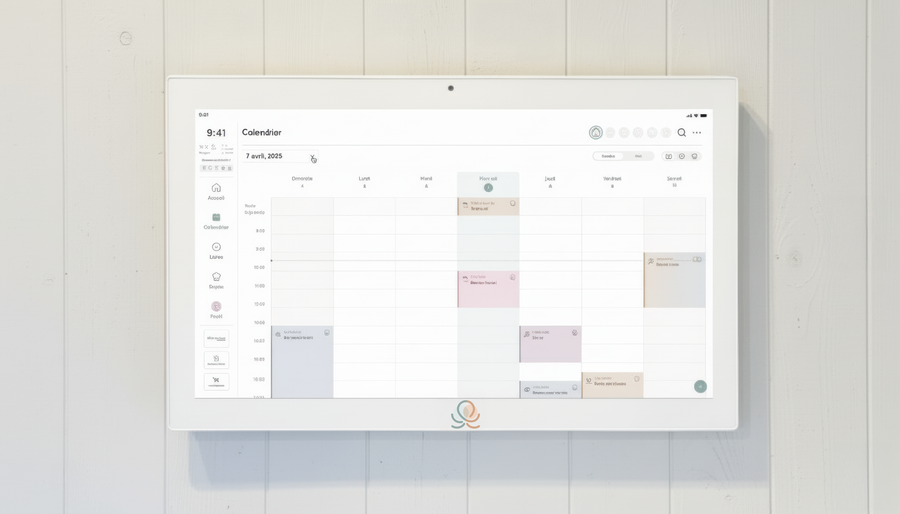
Our virtual family assistant Octave will finally let you see even the invisible tasks; write down every task you think of, and easily assign them to the family members of your choice. It's now up to Octave to carry your mental load!
Take action
Have we convinced you? Then it's time to take action! Block off 90 minutes in your schedule right now and do the work of renegotiating tasks using the advice in this article.
Put these tips into practice
Get the whole family organized with Octave
Meals, chores, the calendar and routines for the whole family in one place: on everyone's phone and on the Station on your wall.
The app is free on iOS and Android.