



New year, new organization: creating a family system that really works
05 January, 2026
As every new year begins, do you resolve to finally organize your family's daily life? And like every year, do you fear seeing your new system collapse by February? What if we told you that the difference between a system that lasts and one that falls apart isn't its complexity or its perfection, but its ability to adapt to your unique family reality?
Step 1: Identify your real challenges
The most common mistake when setting up an organizational system is aiming for perfection rather than functionality. You may admire flawless Pinterest boards or other families' foolproof routines, but those models probably don't fit your particular dynamic.
So start by honestly identifying your real challenges. What creates the most chaos in your daily life? Rushed mornings? Evening homework? Meal planning? Paperwork piling up? Rather than trying to fix everything at once, focus on the two or three major pain points in your daily life that, once solved, will significantly improve your family's quality of life.
Step 2: Involve every family member
A system imposed unilaterally by the parents has little chance of working in the long term. It's therefore essential that the children, even little ones, understand why organization matters and how it directly benefits them. So take the time to hold a family meeting where everyone gets a chance to express what isn't working optimally in the current routine and to propose solutions.
This collaborative approach turns the organizational system into a family project rather than a new parental rule. What's more, children who actively take part in creating routines feel invested and responsible for their success. Even a four-year-old can contribute by identifying what makes their mornings difficult or by suggesting where to put their toys so they're easier to find.
Step 3: Create visual, accessible routines
Routines are the backbone of any effective family organization. However, a routine written on a sheet of paper tucked in a drawer obviously helps no one. So create clear visual aids, displayed in strategic spots where the whole family will see them regularly (our Octave app and our routine box set are ideal tools for this!).
What matters is that these tools are accessible and consulted naturally in the daily flow. A routine chart in the bathroom helps kids get ready in the morning, while a weekly menu displayed in plain sight in the kitchen spares you the eternal question, “What's for dinner?”
Step 4: Simplify before you organize
No organizational system, however sophisticated, can effectively handle a surplus of stuff, activities or commitments. Before putting your new system in place, take the time to take stock of what is really cluttering your family life.
Start by decluttering the critical spaces: the entryway, the kitchen, the kids' bedrooms and the homework space. It's much easier to maintain order in an environment that contains only what you need and what you use regularly. This simplification step can sometimes seem daunting, but it's an investment that will make everything that follows much easier. Feel free to check out our articles on decluttering in the “Organizing” section of our Magazine to help you out!
Also evaluate your family calendar. An organizational system can't make up for an overloaded schedule; if your kids take part in so many extracurricular activities that you spend your evenings in the car, the problem isn't organizational, but rather a question of prioritization!
Step 6: Establish clear zones of responsibility
Fuzzy zones are real enemies of organization. Every family member should know precisely what falls under their responsibility and when the chores that fall to them need to be done. To find out what each child is able to do based on their age and developmental level, take the time to check out our independence pathway, available in the Magazine's “Toolbox.”
Parents also need to clarify their respective zones, so as to better balance the mental load. Who checks the school planners? Who plans the meals? Who coordinates medical appointments? This transparency prevents conflict and ensures that no one carries the weight of family organization alone. Our “Parental Equity” special feature will give you smart advice to get there more easily!
Step 7: Schedule review moments
An organizational system is never set in stone. Your needs evolve with your children's ages, job changes, new activities or unexpected challenges. So schedule a monthly review, for example the first Sunday of every month, to assess what's working and what needs adjusting.
These review moments don't need to be formal or long. Fifteen minutes is enough to ask a few simple questions: What worked well this month? What caused frustration? What could we change to improve our daily life? This flexibility keeps your system alive and relevant.
Step 8: Celebrate the small victories
Family organization isn't perfected overnight. Recognize and celebrate progress, even modest progress. Did your child pack their school bag without a reminder twice this week? Point it out. Did you manage to plan meals for three weeks in a row? That's an achievement worth recognizing.
These celebrations reinforce positive behaviors and keep the whole family motivated. Organization then becomes less of an imposed chore and more of a collective skill you're proud of.
By approaching this new year with realism, collaboration and flexibility, you'll create an organizational system that not only works, but truly improves the quality of life of your whole family!
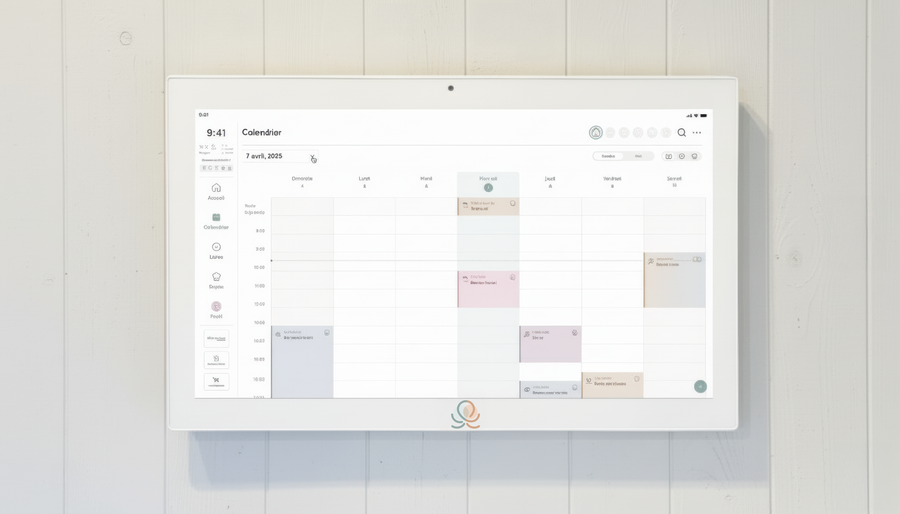
Put these tips into practice
Get the whole family organized with Octave
Meals, chores, the calendar and routines for the whole family in one place: on everyone's phone and on the Station on your wall.
The app is free on iOS and Android.