



The perfect schedule doesn't exist (and that's okay!)
15 October, 2025
You did it. You created THE plan: a structured weekly schedule, tried-and-true morning and evening routines, household chores assigned to each child, an up-to-date family calendar. And yet, every time something unexpected shows up on the agenda (an extra meeting at work, a virus, an appliance that stops working...), you come to the same conclusion: you feel like you failed and that all your efforts were for nothing.
What if we told you instead that the perfect schedule doesn't exist, anywhere, for any family? And what if we told you, on top of that, that you don't really need one?
Why perfection sabotages everything (the all-or-nothing trap)
The quest for the perfect schedule isn't just unrealistic, it's actually harmful.
The all-or-nothing trap
The brain loves extremes; either it's perfect or it's a complete failure. Either you follow the schedule 100%, or you've failed. There's simply no room for the gray area. Yet this binary thinking is a trap when it comes to family organization.
What's going on in your head:
Monday morning, the planned routine doesn't work because your son took 20 minutes to find his shoes. Your brain concludes: “The schedule doesn't work. It's all ruined!”
So you give up. You stop trying because if it's not perfect, why keep going?
Result: You constantly swing between two extremes: rigid total control or complete chaos. Never a happy medium, never a lasting balance.
Perfection that leads to exhaustion
Constantly aiming for perfection is exhausting, as every little slip becomes a potential source of stress. You quickly become tense, irritable and obsessed with sticking to the schedule, at the expense of your family's well-being.
Very often, your kids sense this tension and resist even more. Family harmony becomes harder to achieve and, ironically, the schedule becomes even harder to maintain.
The mathematical impossibility
You don't control everything. Whether you like it or not, kids get sick, the car needs some work, your boss calls last-minute meetings, and more! Believing you can create a schedule that will withstand all these variables is like believing you can control the weather.
Life, by its very nature, is unpredictable, and a rigid schedule that collapses at the first surprise is therefore not built very well.
The 80/20 approach: redefining success
The solution? Completely change your definition of success. Forget perfection and aim instead for imperfect consistency.
The 80% rule
If the schedule and routine you've built work 80% of the time, you're succeeding.
That means a morning routine that works well 4 mornings out of 5 is a success. A week where you stuck to the planned schedule 5 days out of 7 is a sign of excellence. A month where 3 weeks out of 4 went well is a real victory.
And the remaining 20%? That's simply life: the unexpected, the tough days, the sick days. The room needed for human imperfection!
How to apply the 80/20 rule
1. Identify your non-negotiable routines
Select the two or three routines that are truly essential to how your family functions.
For most families, these are:
- The morning routine (to leave on time for school and/or work)
- The bedtime routine (to make sure everyone gets enough hours of sleep)
- One meal eaten together as a family every day
These routines need to work 80% of the time. The rest can afford to be more flexible.
2. Celebrate the 80%
Your daughter forgot to brush her teeth this morning, but all the other steps in the routine were completed? That's a success!
You stuck to your dinner schedule 6 evenings out of 7 this week? You're hitting your goals!
3. Accept “off-schedule” days
Some days, you know, nothing goes as planned. Your daughter is sick, you have an emergency at work and the car won't start. The schedule goes completely out the window.
That's okay. That's normal. And above all, it's not a failure. Tomorrow, you'll simply pick up your usual routine again.
Adjusting to real life
A schedule that works shouldn't be rigid. It should breathe and know how to adapt to the different seasons of life.
Illness: minimal mode
When someone is sick, the normal schedule is obviously suspended, and you need to switch to survival mode instead.
Minimal mode during illness:
- One single goal: everyone eats and sleeps
- Household chores can wait
- Homework can be postponed (after letting the teacher know)
- More screen time is allowed to keep the sick child occupied
- Zero guilt!
Duration: Until everyone has recovered. Then you simply pick your routine back up gradually.
Vacation: relaxation mode
Vacation is certainly not the time to keep to a strict schedule. It's finally time to let go!
Vacation mode:
- Lighter routines
- Flexible schedules (waking up later, shifted mealtimes)
- More spontaneity
- Less structure
Intense periods: essentials mode
End of the school term, the holiday season, a major project at work – some periods are inevitably busier.
Essentials mode during these weeks:
- Keep only the essential routines
- If possible, temporarily eliminate the extras (extracurricular activities, special projects)
- Simplify meals (takeout, frozen meals, sandwiches)
- Delegate what you can (cleaning, grocery delivery)
Duration: As long as it takes to weather the storm. Then gradually reintroduce your usual schedule.
Five imperfect Quebec families who are succeeding
To convince you of the value of adopting the “good-enough schedule,” here are testimonials from real families who gave up on perfection and found a balance that works for them.
Family 1: Mélodie, mom of three kids (ages 6, 9 and 12)
“I stopped trying to have a perfectly tidy house. Now my only goal is ‘clean enough that nobody gets sick.’ We do a quick 15-minute reset together every evening, where we only pick up the essentials. On Saturday, we do a deeper clean. But in between? There are some toys, papers and dishes lying around, and I don't beat myself up about it anymore. My kids play, live, make messes, and that's normal. This imperfect way of handling housework keeps me sane!”
Family 2: Marc and Sophie, parents of twins (age 4)
“We have a basic schedule, but our golden rule is this: if it creates more stress than structure, we let go. For example, we used to have the twins go to bed at 7:30 p.m. sharp. But some nights it turned into a real battle and they'd end up going to bed at 8:30 p.m., them in tears and us completely discouraged. So we pushed the planned bedtime to 8 p.m. Now they go to bed between 7:45 and 8:15 p.m., depending on how things are going, and everyone is happier!”
Family 3: Julie, single mom of two teens (ages 13 and 15)
“I've learned to tell essential routines from the ones that aren't. Essential: everyone eats, sleeps, and gets where they need to be on time. Not essential, but nice to have: a spotless house, gourmet meals, Pinterest-perfect lunches. When I'm swamped at work, I keep the essentials and let the rest go without guilt. Pizza for dinner? Perfect. The teens make their own sandwiches for their lunches? Excellent. They learn independence, and I keep my good mood.”
Family 4: David and Isabelle, parents of four kids (ages 3, 5, 8 and 10)
“Our schedule changes completely in summer compared to winter. In summer, we're super relaxed – no strict routine, the kids go to bed later, we eat outside, it's a happy chaos! When September comes around, we simply bring back the usual structure gradually, two weeks before school starts. I used to try to keep the same rigour all year and I wore myself out. Now I accept that summer is different, and the kids adapt perfectly to the transition when we do it gently.”
The “good enough” vs. “perfect” rule
What is “good enough”?
Good enough is:
- A bedroom where you can walk around without stepping on toys (not a magazine-worthy bedroom)
- A simple, nutritious dinner (not a Michelin-star chef's meal)
- A morning routine that gets you out the door on time 8 times out of 10 (maybe not 10 out of 10)
- Kids whose basic needs are met and who feel loved (not kids who excel in 47 areas)
Embracing “good enough” lets you have:
- Happy, healthy kids
- Less stressed parents
- A functional home
- Harmonious family relationships
- Time and energy to enjoy life
Aiming for perfection brings:
- Parental burnout
- Anxiety
- Kids who feel they're never enough
- Strained relationships
- A lack of fun or spontaneity
How to apply the rule
Before doing a task, ask yourself whether it's possible to do things “well enough,” or whether perfection is really necessary.
Concrete examples:
- Folding the laundry perfectly vs. tossing it into the drawers a bit loosely → Good enough is enough
- Packing a balanced, nutritious lunch vs. a gourmet Instagram lunch → Good enough is enough
- Putting the toys in the right bins vs. putting everything in one big bin → Good enough is enough
- Arriving 5 minutes late vs. arriving exactly on time while yelling at everyone → Good enough is enough
When to give up vs. when to persevere
Wondering whether your schedule deserves to be abandoned or whether you just need to persevere through a tough period? Here are a few tips to help you make an informed decision.
Give up if:
1. It creates more stress than structure
If the schedule generates constant conflict, tears and anxiety, and the overall family atmosphere is negative, it's a clear sign that it's time to give up: a schedule should make life easier, not complicate it.
2. It completely ignores your reality
Did you copy a schedule from the web for a family that gets up at 5 a.m. and does yoga together, but you work nights? Give up on it. Create something that matches your needs and your family's reality instead.
3. Nobody has followed it for months
If after 3 or 4 months absolutely no one in the family is following the schedule, it's because it isn't suited to your needs. Simply start your plan over with something simpler and more realistic.
Persevere if:
1. You're in the initial adjustment period
The first three weeks of a new routine are always hard. Give yourself at least 4 to 6 weeks before judging how well it works.
2. It works 60 to 70% of the time
If your schedule holds up more than half the time, you're on the right track. Adjust the details, but keep the basic structure.
3. The bad days are due to exceptional circumstances
If the schedule works well except when someone is sick or there's a major surprise, the schedule isn't the problem – it's the temporary situation.
Seasonality: the summer schedule vs. the back-to-school schedule
One of the secrets of families who succeed? They accept that their schedule changes with the seasons.
The summer schedule (June to August)
Features:
- Considerably lighter structure
- Later bedtimes
- Morning routines that are nonexistent or very flexible
- Simpler, more casual meals
- Lots of spontaneity
The back-to-school schedule (September to June)
Features:
- Tighter structure
- Consistent bedtimes to ensure enough sleep
- Well-defined morning and evening routines
- Weekly planning of meals and activities
- Greater predictability
Les Belles Combines solutions
Used on our chore chart, on our small routine charts or on our planners, our Magnétos can be moved easily, and even removed when they no longer suit the time of year. Add them to the schedule during the school year, and simply put them away for the vacation!
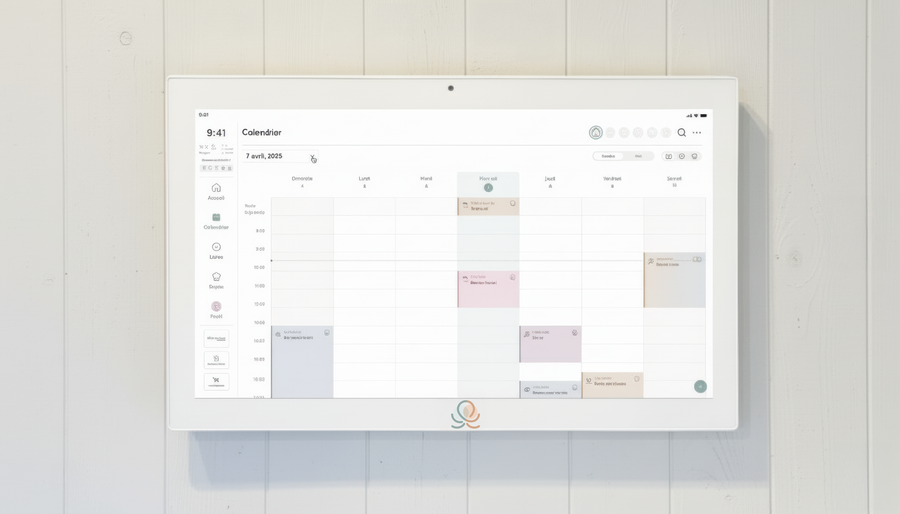
With our virtual family assistant, there's no need to think about making the necessary changes to your schedule depending on the time of year: the app does it automatically for you, according to the plan you've set for vacation time and the one that takes effect from the start of the school year.
Take action
Take the time to adjust your schedule following the advice given in this article, and identify the tasks and routines that seem “good enough” to you. Finally, stop demanding perfection at all times and in all circumstances, starting now!
Put these tips into practice
Get the whole family organized with Octave
Meals, chores, the calendar and routines for the whole family in one place: on everyone's phone and on the Station on your wall.
The app is free on iOS and Android.